Chapter 9: Cosmic Rays, Subatomic Particles
by Tim Hofmann and Steven Newberg
Introduction
The introduction of the idea of subatomic particles started with G Johnstone
Stoney with his prediction of a particle within the atom which carries a minimum unit of
electrical charge. He called this particle an electron and the name stuck when it was
discovered by J. J. Thompson 23 years later. Albert Einstein made a contriubtion to the
field of particle physics among his other contributions by realizing that light was made up of
photons. Rutherford came along in 1907 with his gold foil experiment and proved that the atom
was mostly empty space, and discovered that the center of the Hydrogen atom was positively
charged, consisting of a single proton. Rutherford also hypothesized the existence of
neutrons in other atoms, which was found to be true by James Chadwick in 1932.
Neutrinos were hypothesized by Wolfgang Pauli but were not found for another 24 years,
and were produced by the decay of neutrons. In this time muons, pions, and kaons were all
discovered. Hadrons were the next to be found, by using new particle accelerators in
the 1950's. This is when particle physics really took off, with the completion of the
standard model, a theory describing subatomic particles reactions under the electromagnetic,
weak, and strong forces, defining the period. Recently the field has recieved extra attention
due to some nuetrinos at a particle accelerator in CERN possibly exhibiting faster-than-light travel.
Cosmic Rays
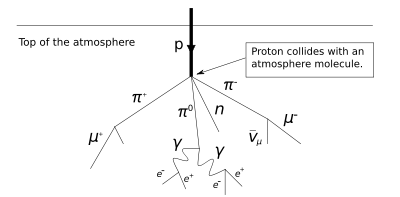
Cosmic rays, as their name indicates, come to the Earth from the cosmos (outer space). Cosmic rays
are charged subatomic particles, which can also create secondary particles secondary particles which
can penetrate the Earth's atmosphere. Cosmic rays mainly consist of particles found on Earth such as
protons and electrons, but can also contain antimatter. Cosmic rays can originate from things as
close as the Sun or as far as the ends of the Universe. Generally the rays coming from the Sun or
in fact, from anywhere in our galaxy, do not have the required energy to penetrate the Earth's
atmosphere, but those cosmic rays coming from farther away are moving much quicker and are able to
pass through it fairly easily. These high energy cosmic rays are extremely hard to detect because
of the low number of times they actually reach us, and because of the nature of their origins,
which is not known, but is theorized to have to have been produced over far greater time periods
than a supernova or any other event in space. These rays arrive with an energy 10^8 that of any
particle accelerator could produce on Earth at the moment, and so these particles and there source
is a great mystery, and scientists are working fervently to find a solution.
Scientists attribute the levels of some of the heavy elements found on Earth to
cosmic rays bringing them, because they have very high levels of these elements as compared to
the Earth's levels. Cosmic rays are also responsible for bringing Carbon-14 to the Earth, as well
as accounting for some of the background radiation felt on Earth. This background radiation
increases as a person increases their altitude. This radiation is a possible danger to people
who work on airplanes, as there extended time in higher elevations exposes them to much higher
radiation levels. This is also a restriction to space travel time, as well as an added requirement
for space vehicles to have a way to reflect some of the excess radiation hitting it.
muons
Antiparticles
Anti-particles are the opposite of particles, meaning that anti-particles have the same
mass as a particle but have an opposite charge. Particles and antiparticles annihilate each other
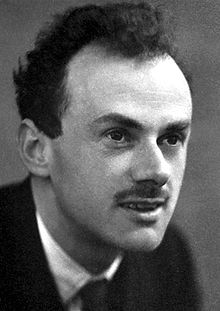
upon contact. Paul Dirac first theorized positrons, the anti-particle of electrons, in 1932. Paul
Dirac used Schrodinger’s equations and came to the conclusion that there would be an electron
particle with a positive charge, which was later experimentally proven.
These anti-particles are not often found in nature, and physicists have no reason for
why the universe contains mostly matter. They are most often found through beta decays and cosmic
rays from outer space. Some types of beta decays produce positrons. Beta plus decay produces
positrons while beta minus decay produces antinutrinos. Also, the decay from radioactive isotopes
can produces anti-particles.
Since anti-particles annihilate particles then their annihilation process produces energy.
This can be in the form of photons or gamma rays. Since anti-particles and particles have the same
charge, then their annihilation means that charge is conserved and energy is conserved because the
reactions produce energy and other particles.
Physicists at CERN have recently been able to produce some anti-hydrogen atoms. This
anti-hydrogen atom is simply a positron and an antiproton. This anti-matter exists for a short
time and this is partially due to the intense heat that must be used to create the anti-particles
and also because the actual probability of a particle accelerator leading to the production of
anti-hydrogen atoms is very low. Since there are so few particles, there is still no data on
these anti-particles and how they relate to matter. There is further study that will hopefully
be able to maintain and empirically test the properties of anti-matter to understand more about
what makes it different from normal matter.
Neutrinos
The word neutrino gives a hint as to what this particle is and how it behaves. The
word is italian and means little neutral one, which describes the particle quite well. It is
indeed very small, far to be small to be seen by the naked eye, and the fact that it is neutral
in charge means that it does not interact with protons or electrons, nor does it feel any push
or pull from the electromagnetic forces that are exerted by these charged particles. It is
believed that nuetrinos have mass, but it is very small, even when compared to other subatomic
particles. This leads to its mass still being a topic of experimentation today.
Neutrinos also do not feel the effects of the strong force, which is responsible for
binding protons and neutrons together in the nucleus of atoms. This leaves the weak force, which
leads to the radioactive decay of subatomic particles, and the gravitational force, though
gravity can almost be neglected in the subatomic scale. Because of all of the factors the neutrino
can actually pass through matter, on the order of several miles at least. Neutrinos are created
in Sun as well as nuclear reactors, and can also be created by cosmic rays hitting atoms
Wolfgang Pauli was the first to suspect that the neutrino had to exist, because
otherwise beta decay would not adhere to conservation of mass, energy, momentum or angular momentum.
Beta decay experiments always concluded with a small percentage of extra mass. energy, and
momentum not being used, and so Pauli decided that there must be some undetected particle that it
also given off in this reaction. He named the particle a neutron, because of its neutral charged
nature, but later James Chadwick discovered the particle we know today as the neutron, and it was
much bigger that Pauli's neutron, so Enrico Fermi, the man who theorized beta decay in the
first place gave the name neutrino to Pauli's particle.
The neutrino was first detected by Clyde Cowan, Frederick Reines, and several other
physicists in 1956 during an experiment where antinneutrinos reacted with protons to produce
neutrons and neutrinos. They were awarded the Nobel Prize for this experiment 40 years afterward.
Like most things in the world, there is not only one type of neutrino. They come in
three different "flavors", the electron neutrino, the muon neutrino, and the tau neutrino.
Each of these flavors also has an antiparticle corresponding with it.In much the same way that
the electron neutrino was found through discrepencies in mass at the beginning and end of beta
decay, so to was the tau neutrino discovered by the same type of discrepency in tau decays.
The Sun is constantly bombarding the Earth with neutrinos (about 10^10 per every square centimeter
of the Earth per second) but it was actually less than what was hypothesized in the 1960's. This
problem was solved by the revelation that the neutrino does indeed have mass and is able to change
its flavor
First Baryons and mesons discovered
Baryons are particles made up of three quarks. Among these particles are the proton and the
neutron. A proton is made up of two up quarks, and one down quark. The charges of these quarks ends up
adding up to the total charge of the particle. Particles that are made up of quarks are also classified as
hadrons. Because protons and neutrons are baryons, most matter is considered to be baryonic matter.
Mesons are subatomic particles, and they are similar to baryons in that they consist of quarks,
but instead of simply having three quarks, mesons have one quark and one antiquark. Mesons, unlike many
baryons, are extremely unstable, and will last at most 10^-8 seconds. Mesons have the ability of either
decaying into electrons and neutrinos, or into photons. Because mesons consist of quarks they are also
classified as hadrons, though they do not contribute to much of the Universe's mass. Hideki Yukawa
predicted the existance of mesons, as a means of carrying the nuclear force, without which the nuclei of
atoms would not stay together. There are quite a few mesons that have been observed, so they have been
classified into five catagories, pseudoscalar mesons, pseudovector mesons, vector mesons, scalar mesons,
and tensor mesons. A mesons will fit into a certain catagory depending on it's spin configuration.
| Name | mass (MeV) | half-life (sec) |
| proton | 938.3 | stable |
| neutron | 939.6 | 881 |
| lambda | 1115.6 | 2.6 x 10⁻¹⁰ |
| sigma | 1189 | 0.8 x 10⁻¹⁰ |
| electron | 0.511 | stable |
| muon | 105.6 | 2.2 x 10⁻⁶ |
| pion | 140 | 2.6 x 10⁻⁸ |
| kaon | 493 | 1.2 x 10⁻⁸ |
| gamma | 0 | stable |
| neutrino | approximately 0 | stable |
quarks
Quarks
Quarks are elementary particles that combine to form baryons and mesons, as well as give these
particles their charge. Some examples of particles that are made up of quarks are protons and electrons.
An interesting thing about quarks, is that as far as is known at the moment, quarks cannot exist by
themselves, nor is it currently possible to observe them.
Quarks come in different flavors just like neutrinos. There are six different quark flavors:
Up, down, strange, charm, top, and bottom. The most abundant of these flavors of quarks are the up and
down varieties. This is because of their low mass, even compared to the other quarks, and so the other
quarks will change into these flavors over time due to decay. The other quarks are generally only the
result of high energy collisions, such as those occuring at the CERN particle accelerator.
The charges of the quarks are either +2/3 or -1/3, where top, up, and charm quarks are all +2/3
and the others are -1/3 charged. Each quark, similar to most other particles in the universe, also have
antiparticles. These antiparticles are exactly similar to the quarks in every way except charge. The
anitquark will have the opposite charge of its quark counterpart (an antiup quark will have a -2/3
charge,because the up quark has a +2/3 charge).
An interesting feature of quarks is that they are the only known particle to be subject to all
four fundamental interactions, those of gravity, electromagnetism, the weak interaction, and the strong
interaction.
The quark was not something that was postulized until 1964 by Murray Gell-Mann, and George
Zweig. They came up with the theory that there were three quark flavors, called up, down and strange, and
that they were what made particles. At first the idea was greeted with a lukewarm reaction as people
weren't sure if quarks actually would exist if it was just a theory to explain something that was not
fully understood. After a while the idea gained traction, and the fourth flavor, charm, was introduced by
Sheldon Glashow and James Bjorken. In 1968, an experiment was done that confirmed that the proton was not
an elementary particle like was previously thought, but they did not identify the particles inside the
proton as quarks, but these were later discovered to be the up and down quarks. Not until 1974, after the
final two quarks had been proposed, did the physics community adopt the quark model as true. There change
of heart came after two groups observed the charm quark bound together with it's antiquark in a meson.
From then the other quarks were found over several years, though the last one, the top quark, was not
discovered until 1995.
Quarks are able to change their flavors. They do this when they are subjected to the weak
interaction. A quark of flavor up, top, or charm, can transform into a down, bottom, or strange by the
emission of a boson. Through this process a neutron can decay into a proton, and electron and an
antineutrino.
Quark Properties:
| Quark | Symbol | Spin | Charge | Baryon
Number | S | C |
B | T | Mass
|
| Up | U | 1/2 | +2/3 | 1/3 | 0 | 0 | 0 | 0 | 1.7-3.3
MeV |
| Down | D | 1/2 | -1/3 | 1/3 | 0 | 0 | 0 | 0 |
4.1-5.8 MeV |
| Charm | C | 1/2 | +2/3 | 1/3 | 0 | +1 | 0 | 0 |
1270 MeV |
| Strange | S | 1/2 | -1/3 | 1/3 | -1 | 0 | 0 | 0 |
101 MeV |
| Top | T | 1/2 | +2/3 | 1/3 | 0 | 0 | 0 | +1 |
172 GeV |
| Bottom | B | 1/2 | -1/3 | 1/3 | 0 | 0 | -1 | 0 |
4.19-4.67 GeV |
Paul Dirac
Carl David Anderson
Mesons
Mesons are subatomic particles with one quark and one antiquark.
They are not elementary particles but are smaller than baryons, which have
three quarks. Charged mesons decay into electrons and neutrinos, while
uncharged mesons can decay into photons.
Mesons are important because they intermediate the nuclear force, or
the strong force. This is the force that holds together protons in the nucleus.
Without the strong force then the protons in the nucleus would repel each
other, but due to mesons, the protons and neutrons in the nucleus actually
attract so that atoms do not fall apart.
Mesons are a hadron particle because they consist of quarks. Mesons
consist of a quark and an antiquark so they do not last for very long and they
are very unstable due to the nature of quarks and antiquarks. They are often
found in cosmic rays and high energy interactions, but can be formed in
particle accelerators. The meson was first theorized by Yukawa when he
theorized about the particle strong force. The first meson was discovered in
1947 and was a pi meson, or pion.
There are different types of mesons that have differing effects on the
strong interaction. There are about 140 types of mesons. The pion, or pi
meson, is very influential in the strong force, while the rho meson is not as
influential in the interaction.
Yukawa
Hideki Yukawa was a Japanese theoretical physicist. He attended the
Kyoto Imperial University and soon after became a lecturer at the
University.
In 1935, Yuawa first published a paper on his theory of mesons, a
product of his interest in theoretical physics and elementary particles. During
this time there was very little knowledge into the interaction of the strong
force between protons and neutrons. Yukawa was the first to introduce the idea
of an elementary particle that intermediated this process.
In 1949, Yukawa received the Nobel Prize, the first Japanese Physicist to do
so. He also taught at Colombia University. Even though Yukawa predicted the
meson in 1935, the discovery of the particle, the pion, was not made until
1947.

Owen Chamberlain and Emilio Segre
Enrico Fermi
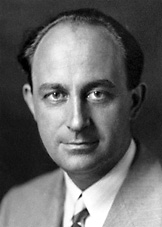
Enrico Fermi
Enrico Fermi was an Italian physicist, and lent his expertise to many a subject
over the span of his life from quantum mechanics to statistical mechanic to nuclear and particle
physics. Fermi is best known for the last two, and is credited as one of the fathers of the atomic bomb.
Fermi became involved with the world of physics as a sort of distraction from the pain
of his father dying of a throat abscess when Fermi was just fourteen years old. From this distraction
came a general interest in physics and while in college he studied subjects of general relativity,
quantum mechanics, and atomic physics.
Fermi was asked to write the appendix for a book named "The Mathematical Theory of
Relativity" and in it he wrote that Einstein's famous formula E=mc^2 could be used to produce
enormous amounts of nuclear energy. This thought would later prove useful for the atomic bomb.
Along with a team of other notable physicists, Fermi was able to make a wide
array of contributions to theoretical and practical physics, including what is know known as the
weak forces, which is the beta decay of particles. They were also close to acheiving the first
instances nuclear fission, which is the seperation of a large element into smaller elements after
giving it a large amount of energy. Fission, at the time was thought to be practically impossible,
though some felt that Fermi's experiments could have achieved it.
Many years later Fermi was living in America. Word had just been recieved that nuclear
fission had been achieved by German chemists, which meant that the Germans were most likely
attempting to build an atomic bomb. Fermi as well as many other scientists were sent to work on
beating them to it. In the early 1940's him and his colleagues had successfully built the first
nuclear reactor, with the first ever self-sustaining nuclear chain reaction. When this was achieved
Arthur Compton, a physicist working with Fermi made a phone call to the chariman of the National
Defense Research Committee saying that "The Italian navigator has landed in the New World"
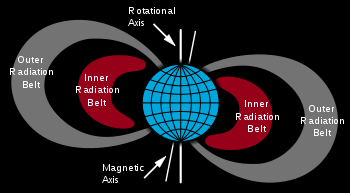
Van Allen Belt
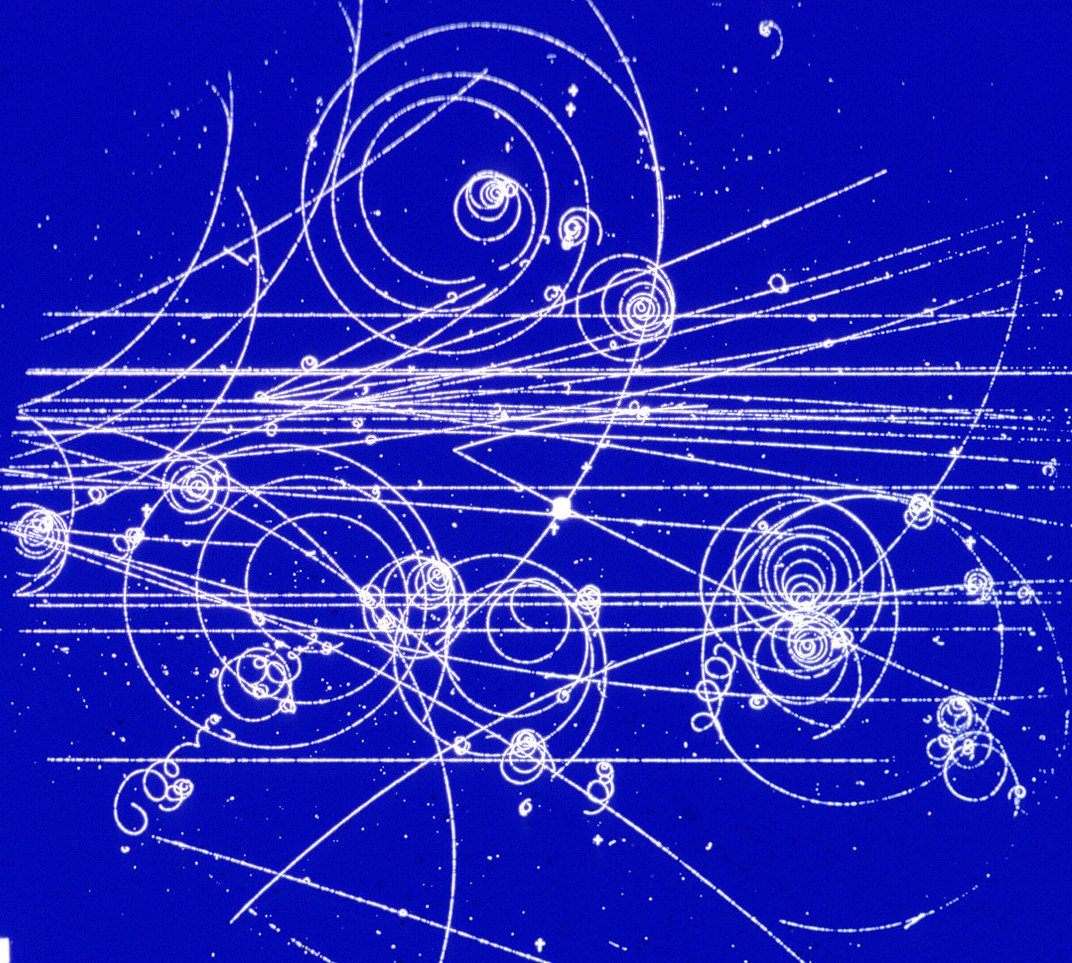
Bubble Chamber Picture
Baryons
Baryons are, like mesons, part of the hadron family of particles,
and the baryon is also made up of quarks. Unlike, the meson, the baryon is made
up of three quarks and is considered a heavier composite particle. Baryons also
have a role in creating the strong force.
An interesting aspect of baryons is the Baryogenesis which is the
process by which there came to exist baryons in the early universe.
Calculations today show that during the Big Bang, there were equally as many
anti-baryons creates as there were baryons. Normally this should mean that all
the baryons and anti-baryons would annihilate each other, but that was not the
case and baryons are very numerous in the universe today.