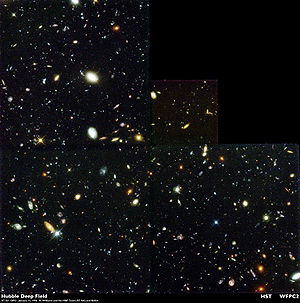
Deep space as seen by the Hubble Telescope:
Classifying Galaxies
Edwin Hubble made something he called the Hubble sequence which is a classification system for the
galaxies that are further and further away. Overall, the galaxies are classified mostly based on their
shape, which can be elliptical, spiral, or barred spiral. This diagram is also known as the Hubble
“tuning fork” diagram. The diagram reads from left to right, starting with the elliptical galaxies. The
 elliptical galaxies are named E0 through E7, the lower the number the more ball-shaped the ellipse is, and
the higher the number the more discus-shaped the ellipse is. These types of galaxies typically have an
older population of stars and have a random motion to them. Galaxies defined as spiral generally have a
central bulge that is surrounded by a disk of younger stars and open star clusters; the arms is where star
formation takes place. The spiral branch galaxies can be defined as S0, Sa, Sb, or Sc, which respectively
goes from having no arms, to very loose arms. The other piece of the fork consists of the barred spiral
galaxies, which are similar to spiral galaxies. The difference is that they also have a band of bright
stars that emerge from the center and extend across the middle of the galaxy, and the arms come out from
the bar rather than the center bulge. The barred spiral galaxy can be classified as SBa, SBb, or SBc.
Respectively, it goes from having tight arms and a brighter center, to looser arms and a dimmer center.
elliptical galaxies are named E0 through E7, the lower the number the more ball-shaped the ellipse is, and
the higher the number the more discus-shaped the ellipse is. These types of galaxies typically have an
older population of stars and have a random motion to them. Galaxies defined as spiral generally have a
central bulge that is surrounded by a disk of younger stars and open star clusters; the arms is where star
formation takes place. The spiral branch galaxies can be defined as S0, Sa, Sb, or Sc, which respectively
goes from having no arms, to very loose arms. The other piece of the fork consists of the barred spiral
galaxies, which are similar to spiral galaxies. The difference is that they also have a band of bright
stars that emerge from the center and extend across the middle of the galaxy, and the arms come out from
the bar rather than the center bulge. The barred spiral galaxy can be classified as SBa, SBb, or SBc.
Respectively, it goes from having tight arms and a brighter center, to looser arms and a dimmer center.
Edwin Hubble
Edwin Hubble was born on November 20, 1889 in Marshfield, Missouri and moved to Wheaton, Illinois
at the age of eleven. He had four siblings As a kid he was known both for his athletic ability and his
intelligence. In 1910 he received his bachelor of science degree at the University of Chicago for
mathematics, astronomy, and philosophy. He was actively involved in a fraternity and later received the
first Rhodes Scholarship enabling him to study three years in Oxford at The Queen’s College. He returned
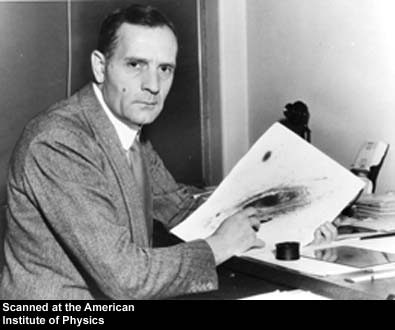
home after his father died to care for his mother and siblings, and then taught for a year at New Albany High School. He continued his studies of astronomy at University of Chicago in the Yerkes Observatory, which is where he received his doctorate degree. Hubble also served as major during WWI for the United States Army, and again later for WWII.
A few years later he became staff at the Mount Wilson Observatory in California, which is where he continued his research until he died in 1953. After he started at the Mount Wilson Observatory, he discovered through the use of the brand new 100-inch Hooker telescope, that there were Cepheid variables in many spiral nebulae, and they were much to far away to be within our galaxy. He discovered entire galaxies outside of our own, which was an entirely new idea at that point in time and changed the view of the universe forever. Hubble is also noted for formulating the Hubble sequence, which is a system that uses photographic images of galaxies to classify them accordingly. In 1929 Hubble discovered that the greater the distance between two separate galaxies, then their relative speed of separation is greater; this was known as the Redshift Distance Law, but is now known as Hubble’s law.
Hubble made these discoveries prior to astronomy being considered a part of physics, but put much effort in to make this accepted, which would allow for astronomers to be considered for the Nobel Prize for their dedication and findings to astrophysics. This effort was not successful before his death, but shortly after astronomy was considered a part of physics. While he was not able to be awarded the Nobel Prize, he was given many other honors with this field. He received the Bruce Medal, the Franklin Medal, the Gold Medal of the ROyal Astronomical Society, and the Legion of Merit. The orbiting Hubble Space telescope was named in his honor. Edwin Hubble passed away in San Marino, California at the age of 63 on September 28, 1953 due to cerebral thrombosis.


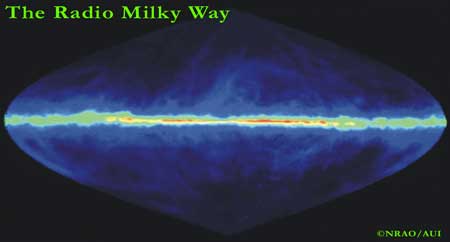
21-cm Hydrogen line
| Component | Fractional Volume |
Scale Height pc |
Temperature (K) |
Density atoms/cm3 |
State of hydrogen | Primary observational techniques |
|---|---|---|---|---|---|---|
| Molecular | < 1% | 80 | 10 - 20 | 102-106 | molecular | Radio and infrared molecular emission and absorption lines |
| Cold Neutral Medium (CNM) | 1-5% | 100-300 | 50-100 | 20-50 | neutral atomic | H-21 cm line absorption |
| Warm Neutral Medium (WNM) | 10-20% | 300-400 | 6000-10000 | 0.2-0.5 | neutral atomic | H-21 cm line emission |
| Warm Ionized Medium (WIM) | 20-50% | 1000 | 8000 | 0.2-0.5 | ionized | H-alpha emission and pulsar dispersion |
| H II regions | < 1% | 70 | 8000 | 102-104 | ionized | H-alpha emission and pulsar dispersion |
| Coronal gas | 30-70% | 1000-3000 | 106-107 | 10-4-10-2 | ionized (metals also highly ionized) |
X-ray emission; absorption lines of highly ionized metals, primarily in the ultraviolet |
Globular Clusters
Quasars
Allan R. Sandage
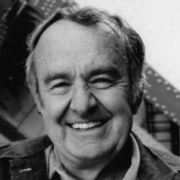
Allan R. Sandage was born on June 18, 1926 in Iowa City, Iowa and was a great American astronomer.
He was an only child to a professor and the daughter of a president of a Mormon school. He first attended
college at Miami University where he studied both physics and philosophy, then later served during WWII.
His alma mater was the University of Illinois, where he graduated in 1948 with a bachelor’s degree and he
later continued onto receive his doctorate’s at the California Institute of Technology. At the California
Institute of Technology, Sandage became a graduate student assistant to Edwin Hubble, a well known
cosmologist, and when Hubble passed away, Sandage continued on his research. At this time, so much was
being discovered about the universe’s age. It went from originally being thought to be 1.8 billion years
to finally 5.5 billion years. Sandage’s main focus of his studies was cosmology and improving the
 cosmological distance scale. He worked at the Palomar Observatory and discovered the first good estimate
for the Hubble constant, and later became even close with a value of 50 km/s/Mpc. Sandage taught physics
at Johns Hopkins University and then later was part of the staff at the Carnegie Observatories in
Pasadena.
cosmological distance scale. He worked at the Palomar Observatory and discovered the first good estimate
for the Hubble constant, and later became even close with a value of 50 km/s/Mpc. Sandage taught physics
at Johns Hopkins University and then later was part of the staff at the Carnegie Observatories in
Pasadena.
Sandage also focused a lot of his research on globular clusters which are spherical collections of stars that orbit galactic cores as satellites. These are highly effected by gravity which causes them to be spherical and have high densities toward the center. http://en.wikipedia.org/wiki/File:A_Swarm_of_Ancient_Stars_-_GPN-2000-000930.jpg Based on Sandage’s studies of these clusters, he was able to predict that the universe had an age closer to fifteen to twenty billion years, rather than seven to thirteen like previously thought.
Another huge discovery for Sandage was a co-discovery of the first optical identification of a quasar with Thomas Matthews, which are also known as quasi stellar radio sources. They were able to detect this during the third Cambridge survey with a compact radio source, where a faint starlike object was at the same position. He also was able to formulate a method of how to identify a quasar based on the excessive amount of ultraviolet or blue radiation they put off. These quasars are known as little blue cosmic objects, which is the location where stars are born. The center of quasars are believed to be black holes, and are the most distant objects in the known universe.
Sandage was huge on research and loved publishing books, even up until the day he died. Over the course of his life he had published hundreds of papers which all helped to further the field of cosmology. He also discovered the Messier 82 galaxy, which is one hundred times brighter than the Milky Way galaxy’s center. He was honored with many awards throughout his career, including the Gold Medal of the Royal Astronomical Society, Elliott Cresson Medal, the Bruce Medal, and the Crofoord Prize. He was married to another astronomer, Mary Connelley and they had two boys together. An interesting fact about him is that later in his life he became a Christian and he focused some of his efforts on writing about religion and science in conjunction. At the age of eighty-four on November 13, 2010 Sandage died of pancreatic cancer in San Gabriel, California where he lived.
Vera Rubin
Dark Matter
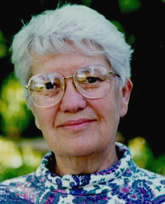
Vera Rubin was born on July 23, 1928 in Philadelphia, Pennsylvania and at the age of 83 is still
alive and well today. She is an American astronomer that is most widely known for her theory on dark
matter and the phenomenon of galaxy rotation problem. She was able to disprove some previously accepted
theories based on her findings about the universe. Rubin received her B.A. at Vassar College and then
attempted to enroll at Princeton University, even though she knew that they didn’t accept women into the
graduate astronomy program. Instead, she applied to Cornell University where she followed her husband,
Bob Rubin, and received her master’s in physics. Around this time, the big bang theory was being accepted
and Rubin presented her thesis as to why she thought that the galaxies rotate around some unknown center.
Rubin earned her first Ph.D. from Georgetown University, and continued to attend classes and received many
more doctorate’s degrees in science from Harvard, Yale, and many other universities. During her studies
 she that the galaxies throughout the universe were not evenly distributed, as the big bang theory stated.
She was able to validate her findings over a decade later with much research.
she that the galaxies throughout the universe were not evenly distributed, as the big bang theory stated.
She was able to validate her findings over a decade later with much research.
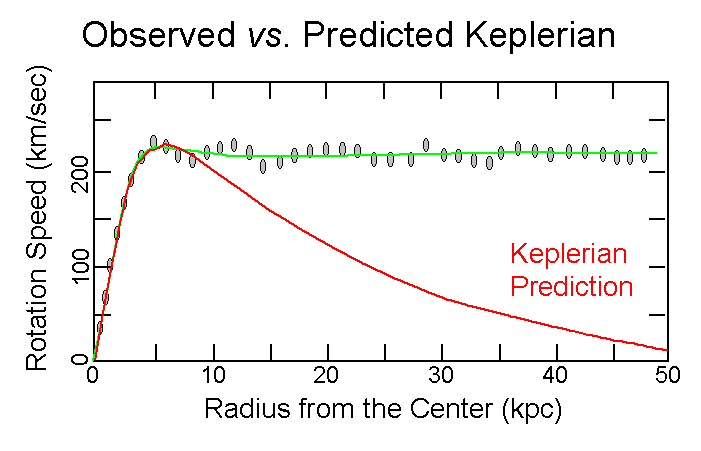
Bob and Vera had four children while she was still working on her doctorate’s degree, both of which are clearly very time consuming. After receiving her doctorate’s degree at Georgetown, she taught there and continued her own research. She then started work at the Carnegie Institution in the Department of Terrestrial Magnetism, and still continues to work there today. In her research in this department, she discovered that the stars on the outside edge of a spiral galaxy orbit at the same speed as the starts toward the center of the galaxy, which again contradicts Newtonian laws of gravity. She discovered the difference between the observed and predicted angular motion of galaxies by studying the galactic rotation curves. Based on her discovery, Vera Rubin believes that around 90% of the universe is made of dark matter, and we only know a very small percentage of what the universe is actually made of.
Rubin holds true to her Jewish roots, and believes that science only enables her to better understand what her role in the world is. She doesn’t think that there is a problem with being a religious scientist. Over the years Rubin has won many awards, including but not limited to the National Medal of Science, the Gold Medal of the Royal Astronomical Society, the Bruce Medal, and lastly in 2011 the American University Honorary Doctor of Science.
Carl K. Seyfert
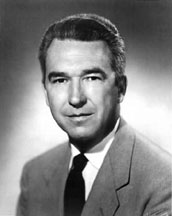
Carl Keenan Seyfert was an American astronomer from Cleveland, Ohio. He was born on
February 11, 1911 and died on at June 13, 1960 in Nashville Tennessee. He attended Harvard
University from 1929 and received his Ph.D. degree in astronomy in 1936. His thesis
was entitled, ?Studies of the External Galaxies? and he focused on galaxies? colors and magnitudes.
This thesis was supervised by fellow astronomer, Harlow Shapley.
From 1936-1940 he worked with a group he started in Texas, McDonald Observatory, to study faint B stars with Daniel M. Popper and continue his research on colors in spiral galaxies. From 1940-1942 he studied at the Mt. Wilson Observatory as part of the National Research Council. He studied active galaxies, which are now known as Seyfert Galaxies. In 1942, he went to the Case Institute of Technology in Cleveland, Ohio. There he dipped into teaching navigation to military personnel and was a part of secret military research.
Seyfert joined the staff at Vanderbuilt University in Nashville, Tennessee in 1946. At first, the observatory was small and equipment was scarce. Seyfert worked continuously to expand the observatory size and technology. He gained a lot of community support and donations and successfully expanded the Arthur J. Dryer Observatory and added a 24-inch reflector in 1953. Seyfert then became director of this observatory until he passed in 1960. He died in a car accident in Nashville.
Carl Seyfert was also well known for his publications in astronomy dealing with stellar and galactic astronomy, observation methods and instruments used. In 1943, he published ?Nuclear Emission in Spiral Nebulae,? that showed galaxies with nuclei that emitted light. An example of these galaxies would be Messier 77, which is now Seyfert Galaxies.
At the Warner and Swasey Observatory in the Case Institute, Seyfert and Nassau photographed the first images of nebulae and stellar spectra. In 1951 he discovered a group of galaxies surrounding NGC 6027, which were then named Seyfert?s Sextet. Seyfert was also an innovator in technology and instrumentation used to identify and research galaxies. A lunar crater and the 24 inch reflector at Dyer Observatory are both named after him.
Bruno B. Rossi
Bruno Benedetto Rossi was born on April 13, 1905 in Venice, Italy. He was an Italian-American
experimental physicist who contributed to cosmic rays and particle physics. He received a Ph.D
from the University of Bologna and began assisting in 1928 at the
University of Florence. There he made various discoveries on cosmic rays. Rossi was also a
professor of experimental physics at the University of Padua but he lost his job because he and
his wife were Jewish. Upon his discharge in 1938, he began travelling
to America.
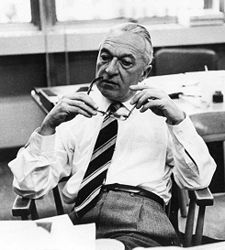
In June 1939, Rossi began his research associate job at the University of Chicago. There, he conducted various experiments and proved for the first time that a fundamental particle, known as the mesotron, could decay and calculated the particle?s mean life at rest.
During WWII, Rossi assisted with the research on radars at the Massachusetts Institute of Technology and later co-directed the development of experiments that would later be used for atomic bombs.
Rossi was appointed as a physics professor at MIT in 1946. He created the Cosmic Ray Group which studied cosmic rays and the sub-nuclear particles that was the outcome of interaction between cosmic rays and matter.
In the 1950?s, Rossi conducted rocket experiments that were used to measure interplanetary plasma. He also consulted the American Science and Engineering, Inc.?s rocket experiments which discovered the first extra-solar source of X-rays.
Rossi also wrote an autobiography entitled ?Moments in the Life of a Scientist? which was released in 1990. He died in 1993 at his Cambridge, Massachusetts home.
Harlow Shapley
He was an American astronomer, born on a Nashville, Missouri farm on November 2, 1885. Shapley dropped out of school in 5th grade and studied at home; covering crime stories as a reporter later. He returned and finished a high school level education in two years.
In 1907, Harlow Shapley went to the University of Missouri to study journalism. Since the program had a wait list for one year, he decided to choose the first major in the school’s catalogue. He could not pronounce archaeology so he decided to study astronomy instead.
Upon graduating from the University of Missouri, Shapley went on to study astronomy under Henry Noris
Russell at Princeton University. Here, he used the period-luminosity relation for Cepheid variable stars;
which was discovered by Henrietta Swan Leavitt; to figure out distances of globular clusters.
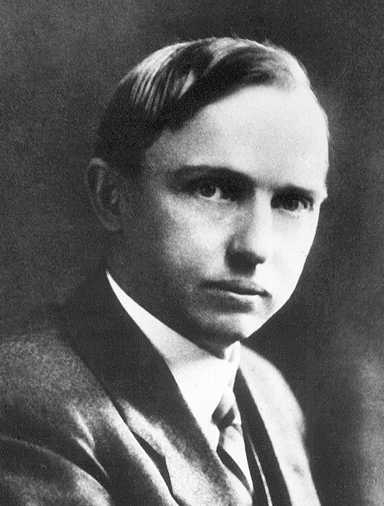
Shapley discovered that Cepheids are pulsators, rather than spectroscopic binaries, that the Milky Way was larger than previously assumed, and that the sun is located in the Milky Way. He also contributed to the Copernican principle in that the earth is not the center of the solar system.
He is also known for debating Heber D. Curtis in the “Great Debate” on whether spiral nebulae (modern-day galaxies) are located in the Milky Way. Shapley was pro this issue but lost to Curtis since he explained the matter in an elementary way in order to impress the Harvard delegation who were choosing a new director for the college’s observatory. Curtis won and his claims were proved true by Edward Hubble’s discovery of Cepheid stars in the galaxy of Andromeda. Harlow Shapley publicly, and incorrectly, opposed Hubble’s discoveries of additional galaxies in the universe and claimed them to be “junk science.”
Before the “Great Debate,” Shapley was hired by George Ellery Hale to work at the Mount Wilson Observatory. After the debate, he replaced Edward Charles Pickering as the new director at Harvard College Observatory from 1921-1952. He also hired Cecilia Payne-Gaposchkin to work at HCO. In 1925, she received the first doctorate in astronomy at Radcliffe College. One of the many books he wrote based on his studies was Source Book in Astronomy.
Among his recognitions, Shapley was involved with the original Foundation for the Study of Cycles in 1941; the board of trustees of Science Service (modern-day Society for Science & the Public) from 1935-1971; and founding government funded scientific associations such as the National Science Foundation. He is also accredited for the “S” in United Nations Educational, Science and Cultural Organization (NESCO). In 1947, Shapley was the president of the American Association for the Advancement of Science; stating in his inaugural address that global threats were: genius primates, drugs that reduced sexual desire, boredom, world wars with weapons of mass destruction, and plague epidemics.
In 1950, he organized an academic campaign against the “pseudoscience” found in Worlds in Collision by the Russian psychiatrist, Immanuel Velikovsky. He wrote Of Stars and Men, in 1957 terming “metagalaxies” as super galaxies. Aside from astronomy, Shapley had a lifelong interest in studying ants, also known as myrmecology.
Shapley married Martha Betz in 1914, whom assisted his studies at Mount Wilson and Harvard College Observatory. The couple had one daughter and four sons, one being Lloyd Shapley, a known mathematician and economist.
His awards include the Henry Draper Medal in 1926, the Gold Medal of the Royal Astronomical Society in 1934, and the Bruce Medal in 1939. He died in Boulder, Colorado on October 20, 1972.